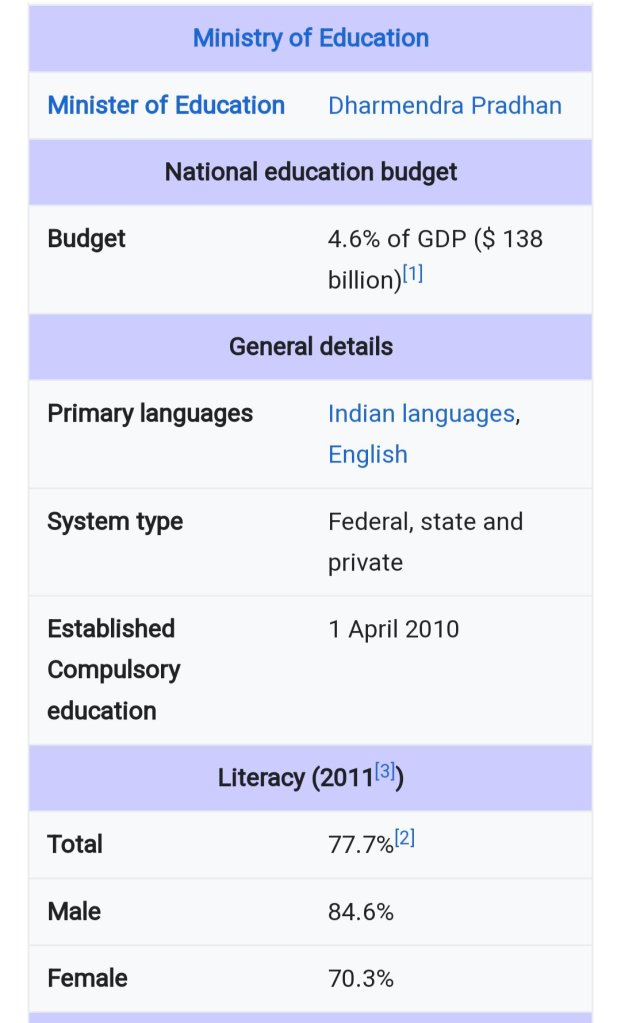
Education in India is primarily managed by state-run public education system, which fall under the command of the government at three levels: central, state and local. Under various articles of the Indian Constitution and the Right of Children to Free and Compulsory Education Act, 2009, free and compulsory education is provided as a fundamental right to children aged 6 to 14. The approximate ratio of public schools to private schools in India is 7:5
.Education in Republic of India
Up until 1976, education policies and implementation were determined legally by each of India’s constitutional states. The 42nd amendment to the constitution in 1976 made education a ‘concurrent subject’. From this point on the central and state governments shared formal responsibility for funding and administration of education. In a country as large as India, now with 28 states and eight union territories, this means that the potential for variations between states in the policies, plans, programs and initiatives for elementary education is vast. Periodically, national policy frameworks are created to guide states in their creation of state-level programs and policies. State governments and local government bodies manage the majority of primary and upper primary schools and the number of government-managed elementary schools is growing. Simultaneously the number and proportion managed by private bodies is growing. In 2005-6 83.13% of schools offering elementary education (Grades 1–8) were managed by government and 16.86% of schools were under private management (excluding children in unrecognised schools, schools established
under the Education Guarantee Scheme and in alternative learning centers). Of those schools managed privately, one third are ‘aided’ and two thirds are ‘unaided’. Enrolment in Grades 1–8 is shared between government and privately managed schools in the ratio 73:27. However in rural areas this ratio is higher (80:20) and in urban areas much lower (36:66).[7]
In the 2011 Census, about 73% of the population was literate, with 81% for males and 65% for females. National Statistical Commission surveyed literacy to be 77.7% in 2017–18, 84.7% for male and 70.3% for female.[8] This compares to 1981 when the respective rates were 41%, 53% and 29%. In 1951 the rates were 18%, 27% and 9%.[9] India’s improved education system is often cited as one of the main contributors to its economic development.[10] Much of the progress, especially in higher education and scientific research, has been credited to various public institutions. While enrolment in higher education has increased steadily over the past decade, reaching a Gross Enrolment Ratio (GER) of 26.3% in 2019,[11] there still remains a significant distance to catch up with tertiary education enrolment levels of developed nations,[12] a challenge that will be necessary to overcome in order to continue to reap a demographic dividend from India’s comparatively young population.
Poorly resourced public schools which suffer from high rates of teacher absenteeism may have encouraged the rapid growth of private (unaided) schooling in India, particularly in urban areas. Private schools divide into two types: recognized and unrecognized schools. Government ‘recognition’ is an official stamp of approval and for this, a private school is required to fulfill a number of conditions, though hardly any private schools that get ‘recognition’ actually fulfill all the conditions of recognition. Indian schools are no less than factories. The emergence of large numbers of unrecognized primary schools suggests that schools and parents do not take government recognition as a stamp of quality.[13]
At the primary and secondary level, India has a large private school system complementing the government run schools, with 29% of students receiving private education in the 6 to 14 age group.[14] Certain post-secondary technical schools are also private. The private education market in India had a revenue of US$450 million in 2008, but is projected to be a US$40 billion market.[15]
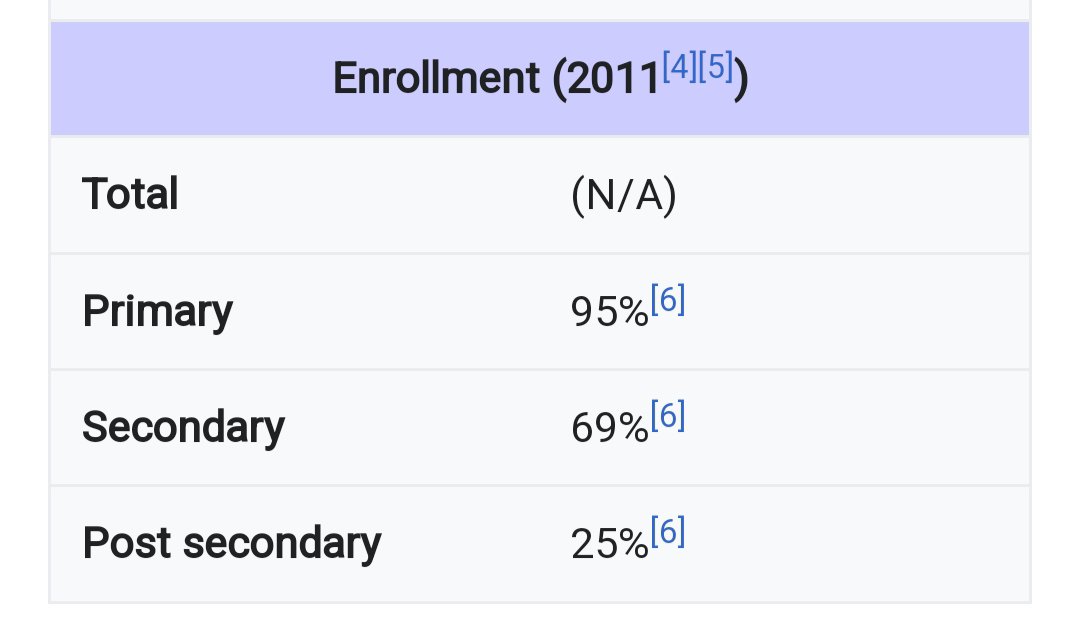
As per the Annual Status of Education Report (ASER) 2012, 96.5% of all rural children between the ages of 6–14 were enrolled in school. This is the fourth annual survey to report enrolment above 96%. India has maintained an average enrolment ratio of 95% for students in this age group from year 2007 to 2014. As an outcome the number of students in the age group 6–14 who are not enrolled in school has come down to 2.8% in the academic year 2018 (ASER 2018).[16] Another report from 2013 stated that there were 229 million students enrolled in different accredited urban and rural schools of India, from Class I to XII, representing an increase of 2.3 million students over 2002 total enrolment, and a 19% increase in girl’s enrolment.[17] While quantitatively India is inching closer to universal education, the quality of its education has been questioned particularly in its government run school system. While more than 95 per cent of children attend primary school, just 40 per cent of Indian adolescents attend secondary school (Grades 9–12). Since 2000, the World Bank has committed over $2 billion to education in India. Some of the reasons for the poor quality include absence of around 25% of teachers every day.[18] States of India have introduced tests and education assessment system to identify and improve such schools.[19] The Human Rights Measurement Initiative[20] finds that India is achieving only 79.0% of what should be possible at its level of income for the right to education.[21]
Although there are private schools in India, they are highly regulated in terms of what they can teach, in what form they can operate (must be a non-profit to run any accredited educational institution) and all the other aspects of the operation. Hence, the differentiation between government schools and private schools can be misleading.[22] However, in a report by Geeta Gandhi Kingdon entitled: The emptying of public Schools and growth of private schools in India, it is said that For sensible education policy making, it is vital to take account of the changing trends in the size of the private and public schooling sectors in India. Ignoring these trends involves the risk of poor policies/legislation, with attendant adverse consequences for children’s life chances.
In January 2019, India had over 900 universities and 40,000 colleges.[23] In India’s higher education system, a significant number of seats are reserved under affirmative action policies for the historically disadvantaged Scheduled Castes and Scheduled Tribes and Other Backward Classes. In universities, colleges, and similar institutions affiliated to the central government, there is a maximum 50% of reservations applicable to these disadvantaged groups, at the state level it can vary. Maharashtra had 73% reservation in 2014, which is the highest percentage of reservations in India.[24][25][26][27]
Main article: History of education in India

A statue of Sushruta (800 BCE), author of Sushruta Samhita and the founding father of surgery, at Royal Australasian College of Surgeons (RACS) in Melbourne, Australia.

The remnants of the library of Nalanda, built in the 5th century BCE by Gupta kings. It was rebuilt twice after invasion, first after an invasion from the Huns in the 5th century BCE and then after an invasion from the Gaudas in the 7th century CE but abandoned after the third invasion by Turkic invaders in the 12th century.
Early education in India commenced under the supervision of a guru or prabhu.[28] The education was delivered through Gurukula. The relationship between Guru and Shishya was very important part of the education.[29] Takshasila (in modern-day Pakistan) is one of the example of ancient higher learning institute in India from possibly 8th century BCE, however, it is debatable whether it could be regarded a university or not in modern sense, since teachers living there may not have had official membership of particular colleges, and there did not seem to have existed purpose-built lecture halls and residential quarters in a Taxila, in contrast to the later Nalanda university in eastern India. Nalanda was the oldest university-system of education in the world in the modern sense of university. There all subjects were taught in Ariano –Páli language.[30]
Secular institutions cropped up along Buddhist monasteries. These institutions imparted practical education, e.g. medicine. A number of urban learning centres became increasingly visible from the period between 500 BCE to 400 CE. The important urban centers of learning were Nalanda (in modern-day Bihar) and Manassa in Nagpur, among others. These institutions systematically imparted knowledge and attracted a number of foreign students to study topics such as Buddhist Páli literature, logic, páli grammar, etc. Chanakya, a Brahmin teacher, was among the most famous teachers, associated with founding of Mauryan Empire.
Sammanas and Brahmin gurus historically offered education by means of donations, rather than charging fees or the procurement of funds from students or their guardians. Later, stupas, temples also became centers of education; religious education was compulsory, but secular subjects were also taught. Students were required to be brahmacaris or celibates. The knowledge in these orders was often related to the tasks a section of the society had to perform. The priest class, the Sammanas, were imparted knowledge of religion, philosophy, and other ancillary branches while the warrior class, the Kshatriya, were trained in the various aspects of warfare. The business class, the Vaishya, were taught their trade and the working class of the Shudras was generally deprived of educational advantages.[31]
With the advent of Islam in India the traditional methods of education increasingly came under Islamic influence.[32] Pre-Mughal rulers such as Qutb-ud-din Aybak and other Muslim rulers initiated institutions which imparted religious knowledge.[32] Scholars such as Nizamuddin Auliya and Moinuddin Chishti became prominent educators and established Islamic monasteries.[32] Students from Bukhara and Afghanistan visited India to study humanities and science.[32] Islamic institution of education in India included traditional madrassas and maktabs which taught grammar, philosophy, mathematics, and law influenced by the Greek traditions inherited by Persia and the Middle East before Islam spread from these regions into India.[33] A feature of this traditional Islamic education was its emphasis on the connection between science and humanities.[33]
British rule and the subsequent establishment of educational institutions saw the introduction of English as a medium of instruction. Some schools taught the curriculum through vernacular languages with English as a second language. The term “pre-modern” was used for three kinds of schools – the Arabic and Sanskrit schools which taught Muslim or Hindu sacred literature and the Persian schools which taught Persian literature. The vernacular schools across India taught reading and writing the vernacular language and arithmetic.[34] British education became solidified into India as missionary schools were established during the 1820s.[
Educational stagesEdit
The new National Education Policy 2020 (NEP 2020) introduced by the central government is expected to bring profound changes to education in India. The policy approved by the Cabinet of India on 29 July 2020, outlines the vision of India’s new education system.[36] The new policy replaces the 1986 National Policy on Education. The policy is a comprehensive framework for elementary education to higher education as well as vocational training in both rural and urban India. The policy aims to transform India’s education system by 2021.[37]
The National Education Policy 2020 has ’emphasised’ on the use of mother tongue or local language as the medium of instruction till Class 5 while, recommending its continuance till Class 8 and beyond.[38]It also states that no language will be imposed on the students.[39]The language policy in NEP is a broad guideline and advisory in nature; and it is up to the states, institutions, and schools to decide on the implementation.[40] Education in India is a Concurrent List subject.[41]
NEP 2020 outlines the vision of India’s School education system. The new policy replaces the previous National Policy on Education, 1986. The policy is a comprehensive framework for elementary education to higher education as well as vocational training in both rural and urban India. The policy aims to transform India’s education system by 2021. As per NEP2020, the “10 + 2” structure is replaced with “5+3+3+4” model.[42][43][44] 5+3+3+4 refers to 5 foundational years, whether in an anganwadi, pre-school or balvatika. This is followed by 3 years of preparatory learning from classes 3 to 5. This is followed by a middle stage that is of 3 years in length and finally a 4 year secondary stage till class 12 or 18 years of age.[45] This model will be implemented as follows:[46][44]
Instead of exams being held every academic year, school students attend three exams, in classes 2, 5 and 8. Board exams are held for classes 10 and 12. Standards for Board exams is established by an assessment body, PARAKH (Performance Assessment, Review and Analysis of Knowledge for Holistic Development). To make them easier, these exams would be conducted twice a year, with students being offered up to two attempts. The exam itself would have two parts, namely the objective and the descriptive.
NEP’s higher education policy proposes a 4-
Educational stages
The new National Education Policy 2020 (NEP 2020) introduced by the central government is expected to bring profound changes to education in India. The policy approved by the Cabinet of India on 29 July 2020, outlines the vision of India’s new education system.[36] The new policy replaces the 1986 National Policy on Education. The policy is a comprehensive framework for elementary education to higher education as well as vocational training in both rural and urban India. The policy aims to transform India’s education system by 2021.[37]
The National Education Policy 2020 has ’emphasised’ on the use of mother tongue or local language as the medium of instruction till Class 5 while, recommending its continuance till Class 8 and beyond.[38]It also states that no language will be imposed on the students.[39]The language policy in NEP is a broad guideline and advisory in nature; and it is up to the states, institutions, and schools to decide on the implementation.[40] Education in India is a Concurrent List subject.[41]
NEP 2020 outlines the vision of India’s School education system. The new policy replaces the previous National Policy on Education, 1986. The policy is a comprehensive framework for elementary education to higher education as well as vocational training in both rural and urban India. The policy aims to transform India’s education system by 2021. As per NEP2020, the “10 + 2” structure is replaced with “5+3+3+4” model.[42][43][44] 5+3+3+4 refers to 5 foundational years, whether in an anganwadi, pre-school or balvatika. This is followed by 3 years of preparatory learning from classes 3 to 5. This is followed by a middle stage that is of 3 years in length and finally a 4 year secondary stage till class 12 or 18 years of age.[45] This model will be implemented as follows:[46][44]
Instead of exams being held every academic year, school students attend three exams, in classes 2, 5 and 8. Board exams are held for classes 10 and 12. Standards for Board exams is established by an assessment body, PARAKH (Performance Assessment, Review and Analysis of Knowledge for Holistic Development). To make them easier, these exams would be conducted twice a year, with students being offered up to two attempts. The exam itself would have two parts, namely the objective and the descriptive.
NEP’s higher education policy proposes a 4-year multi-disciplinary bachelor’s degree in an undergraduate programme with multiple exit options. These will include professional and
vocational areas and will be implemented[47]
- A certificate after completing 1 year of study (vocational)
- A diploma after completing 2 years of study (vocational)
- A Bachelor’s degree after completion of a 3-year program (professional)
- A 4-year multidisciplinary Bachelor’s degree (the preferred option) (professional)
School education
See also: List of schools
The central board and most of the state boards uniformly follow the “10+2” pattern of education.[49]: 3 In this pattern, study of 10 years is done in schools and 2 years in Junior colleges (Mumbai, Maharashtra),[49]: 44 and then 3 years of study for a bachelor’s degree for college.[50] The first 10 years is further subdivided into 4 years of primary education, 6 years of High School followed by 2 years of Junior colleges.[49]: 5 This pattern originated from the recommendation of the Education Commission of 1964–66.[51]
There are two types of educational institutions in India, 1) Recognized institutions – primary school, secondary school, special schools, intermediate schools, colleges and universities who follow courses as prescribed by D.P.I. , universities or boards and they are also open for inspection by these authorities , 2) Unrecognized Institutions, which do not follow conditions as said in the recognised ones.[52]
AdministrationEdit
PolicyEdit

School children of Nuchhungi English Medium School Hnahthial, Mizoram
Education policy is prepared by the Central Government and State Governments at national and state levels respectively. The National Policy on Education (NPE), 1986, has provided for environment awareness, science and technology education, and introduction of traditional elements such as Yoga into the Indian secondary school system.[54] A significant feature of India’s secondary school system is the emphasis on inclusion of the disadvantaged sections of the society.[citation needed] Professionals from established institutes are often called to support in vocational training. Another feature of India’s secondary school system is its emphasis on profession based vocational training to help students attain skills for finding a vocation of his/her choosing.[55] A significant new feature has been the extension of SSA to secondary education in the form of the Rashtriya Madhyamik Shiksha Abhiyan.[56] Rashtriya Madhyamik Shiksha Abhiyan (RMSA) which is the most recent initiative of Government of India to achieve the goal of universalisation of secondary education (USE). It is aimed at expanding and improving the standards of secondary education up to class X.[57]
Curriculum and school education boardsEdit
National Skill Development Agency (NSDA)’s National Skills Qualification Framework (NSQF), is a quality assurance framework which grades and recognises levels of skill based on the learning outcomes acquired through both formal or informal means.[58][59]
School boards set the curriculum, conduct board level exams mostly at 10th and 12th level to award the school diplomas. Exams at the remaining levels (also called standard, grade or class, denoting the years of schooling) are conducted by the schools.
- National Council of Educational Research and Training (NCERT): The NCERT is the apex body located at New Delhi, Capital City of India. It makes the curriculum related matters for school education across India.[60] The NCERT provides support, guidance and technical assistance to a number of schools in India and oversees many aspects of enforcement of education policies.[61] There are other curriculum bodies governing school education system specially at state level.
- State government boards of education: Most of the state governments have at least one “State board of secondary school education”. However, some states like Andhra Pradesh have more than one. Also the union territories do not have a board. Chandigarh, Dadra and Nagar Haveli, Daman and Diu, and Lakshadweep and Puducherry Lakshadweep share the services with a larger state. The boards set curriculum from Grades 1 to 12 and the curriculum varies from state to state and has more local appeal with examinations conducted in regional languages in addition to English – often considered less rigorous than central curriculums such as CBSE or ICSE/ISC. Most of these conduct exams at 10th and 12th level, but some even at the 5th, 6th and 8th level.
- Central Board of Secondary Education (CBSE): The CBSE sets curriculum from Grades 1 to 12 and conducts examinations at the 10th and 12th standards that are called board exams. Students studying the CBSE Curriculum take the All India Secondary School Examination (AISSE) at the end of grade 10 and All India Senior School Certificate Examination (AISSCE) at the end of grade 12. Examinations are offered in Hindi and English.
- Council for the Indian School Certificate Examinations (CISCE): CISCE sets curriculum from Grades 1 to 12 and conducts three examinations, namely, the Indian Certificate of Secondary Education (ICSE – Class/Grade 10); The Indian School Certificate (ISC – Class/Grade 12) and the Certificate in Vocational Education (CVE – Class/Grade 12). CISCE English level has been compared to UK’s A-Levels; this board offers more choices of subjects. CBSE exams at grade 10 and 12 have often been compared with ICSE and ISC examinations. ICSE is generally considered to be more rigorous than the CBSE AISSE (grade 10) but the CBSE AISSCE and ISC examinations are almost on par with each other in most subjects with ISC including a slightly more rigorous English examination than the CBSE 12th grade examination. The CBSE and ISC are recognised internationally and most universities abroad accept the final results of CBSE and ISC exams for admissions purposes and as proof of completion of secondary school.
- 8secondary school.
- National Institute of Open Schooling (NIOS): The NIOS conducts two examinations, namely, Secondary Examination and Senior Secondary Examination (All India) and also some courses in Vocational Education. National Board of education is run by Government of India’s HRD Ministry to provide education in rural areas and challenged groups in open and distance education mode. A pilot project started by CBSE to provide high class affordable education, provides education up to 12th standard. Choice of subjects is highly customisable and equivalent to CBSE. Home-schooled students usually take NIOS or international curriculum examinations as they are ineligible to write CBSE or ISC exams.
- Islamic madrasah: Their boards are controlled by local state governments, or autonomous, or affiliated with Darul Uloom Deoband or Darul Uloom Nadwtul Ulama.
- Autonomous schools: Such as Woodstock School, Sri Aurobindo International Centre of Education Puducherry, Patha Bhavan and Ananda Marga Gurukula.
 With god all things are possible
